
Culinary School
Lessons from the line

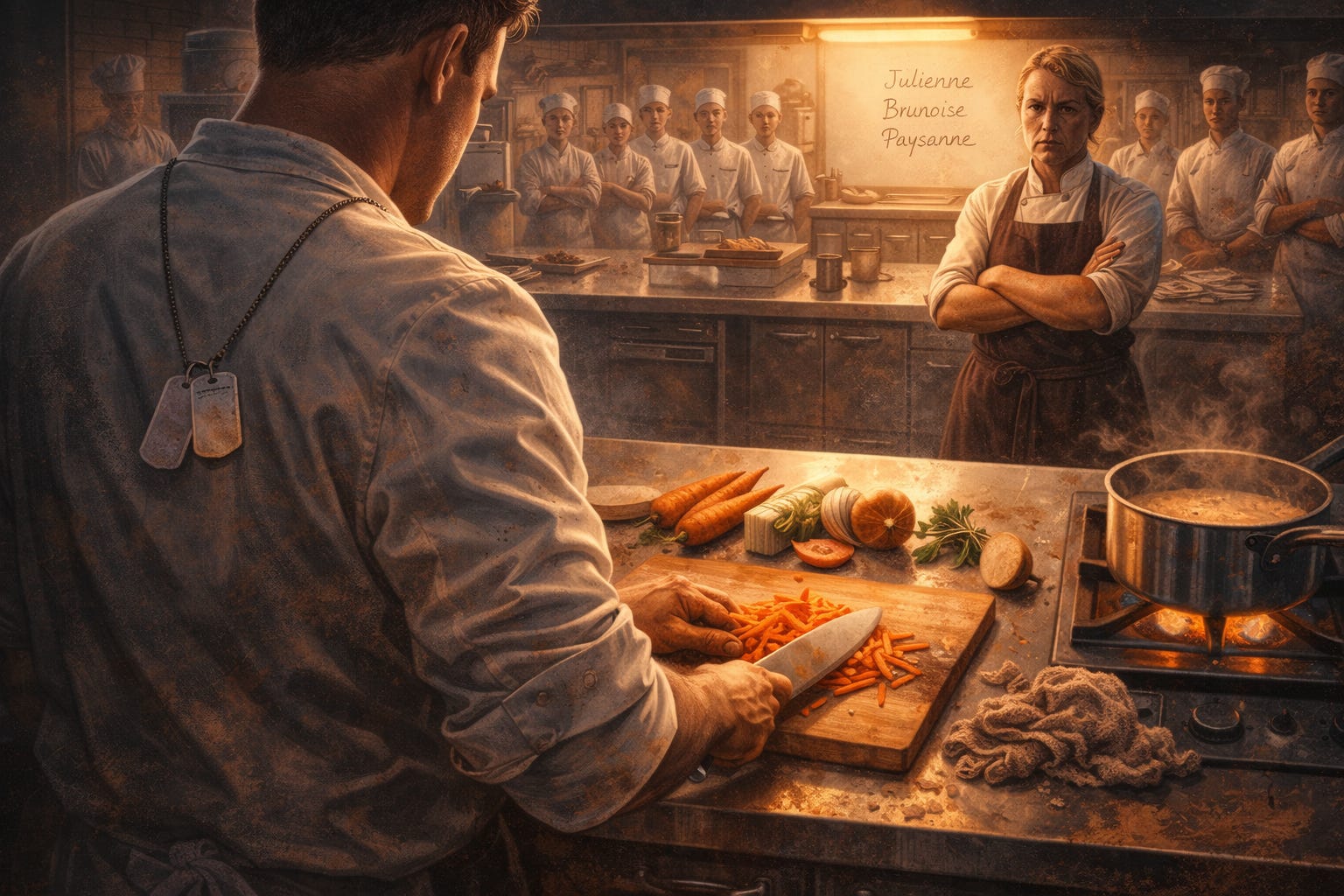
Culinary School was the first place I willingly let someone yell at me again after the military. Only this time it wasn’t because of a crooked cover or a string dangling from my pocket, I would get dressed down for the crime of a ragged julienne. Apparently, in this world I was transitioning to, the way you cut a carrot said something deep about your soul. In the beginning, according to Chef, I was lazy, distracted, and flirting with disaster. To be fair, they weren’t entirely wrong.
I thought I had the advantage walking into Culinary School that first day. I knew chain of command, uniforms, pressure, and inspections. How different could it be? Turns out swapping boots for clogs and an M-4 for an eight-inch chef’s knife doesn’t translate as clearly as the recruiters and shiny brochures made it sound. In the military I knew the language. In Culinary school, I had to learn French terminology, and no one was slowing down long enough for me to write it down.
“Mise en Place, people! Where’s your mise?”
“Start your roux, then build our béchamel”
“Mother sauces today, derivatives tomorrow, don’t embarrass me.”
Mother Sauces. That was the first time I realized this is not a “learn to cook” camp. The French in their infinite opinion, decided there were five pillars of civilization: béchamel, velouté, espagnole, tomato, and hollandaise. If you don’t respect them, you were not cooking, you were heating up food. These sauces were treated like sacred texts. Overcook your roux? Blasphemy.
I’d stand there in my too-stiff chef coat, whisk in hand, trying to get my béchamel smooth while chef prowled behind us like a hungry cat. My forearm burning, you don’t dare stop whisking, because the second you do, that’s when she would appear behind you at your station. Same radar as the Drill Instructor back in the day, some sixth sense that alerts leadership you are thinking about relaxing.
What nobody tells you about transition is that it’s not the big things that break you, it’s the small humiliations. Not knowing where to stand. Not knowing when to jump in. Realizing you were once the one people looked to for answers, and now you’re the guy in the back squinting at the whiteboard trying to spell “espagnole” without looking like you’re copying your neighbor.
In the service, I briefed commanders. In culinary school, I was scared to ask, “What’s the difference between a brunoise and a small dice again?” because the eighteen-year-old next to me already knew, and I was supposed to be the “mature student.” Funny thing about pride, nobody needs to smoke you anymore. You’ll do it to yourself.
Then came the knife skills exams.
If hell has an orientation week, it’s a line of stainless-steel tables, a pile of vegetables, and a stack of cutting boards, with a clock ticking down while a chef watches you like she’s sizing you up for organ donation. Onions, carrots, leeks. Julienne, brunoise, paysanne. Everything by the book, everything to spec.
I’d done stress. I’d done “we might not all make it home” stress. But there’s a special flavor of anxiety that comes from knowing your entire grade hinges on whether your carrot sticks are all exactly three inches by an eighth of an inch, and there’s a person at the front of the room who can spot a crooked cut from across the kitchen like a sniper calling windage.
Your world shrinks to steel and vegetable. Grip the knife. Tuck your fingers. Rock the blade. Breathe. Don’t think about how your hands are shaking more than they did overseas. Don’t think about the fact that this exam is “just cooking school” and somehow, you’re more terrified of disappointing this chef than you were of getting yelled at by a First Sergeant.
She comes by, picks up a little pile of your carefully cut carrots, and lets them fall back to the board like she’s weighing your soul. There’s a pause where your whole nervous system holds its breath.
“Better,” she says. “Still ugly. But better.”
And here’s the twisted part: that tiny, begrudging “better” hit harder than some medals ever did. External validation is a hell of a drug, especially when you’re rebuilding an identity from scratch.
There was bias baked into all of it, mine and theirs. They saw “military” and assumed I’d be squared away, disciplined, unbreakable. I saw “culinary” and assumed it would be easily compared to the life I’d just left. Both of us were wrong. This wasn’t war, but it demanded a different kind of toughness: the vulnerability to suck at something, in public, every single day, and come back tomorrow anyway. The willingness to take feedback that felt personal but wasn’t. The humility to let an 18-year-old line cook correct your grip on a knife without pulling rank you no longer had.
Somewhere between the broken hollandaise and the passable brunoise, I realized what this chapter was really about. It wasn’t learning the mother sauces. It wasn’t taming the knife. It was learning how to be a beginner again without hating myself for it.
This idea exposes something; we don’t like to admit most of us would rather stay in a life that’s slowly killing us than step into a room where we’re the least competent person there. We cling to the old rank, the old stories, the old war tales, because they’re safer than saying, “I don’t know how to do this, but I want to learn.” Culinary school didn’t just teach me how to make béchamel; it forced me to decide whether I was willing to be new again. To be raw, awkward, and underseasoned.
Turns out, the real exam wasn’t knife skills. It was whether I could put down the old identity, pick up the knife, and keep cutting, crooked at first, then cleaner, while I figured out who the hell I was becoming.
Great article! "It was learning how to be a beginner again without hating myself for it." ...this hits home... I couldn't agree more with people being 'comfortable' and sticking to the 'old' stories, but as the saying goes, there is no reward without risk! There is strength in vulnerability and most people aren't willing to step outside their (comfort) zone to see what the rest of the world truly has to offer!